
Operations
Why Answering Your Own Shopify Tickets Leads to Founder Burnout in 6 Months
By Patrick · Founder, Virtual Freelance Solutions · 10+ years in eCommerce customer support
Welcome to the hidden trap of e-commerce success
In the early days of launching a brand, talking to your first few customers is exhilarating. It provides a direct line to product feedback and helps you build a loyal community. But as order volumes scale, that trickle of inquiries quickly turns into a tsunami. Before you know it, you are spending more time apologizing for shipping delays than you are growing your brand.
If you are frantically searching for information on Shopify customer service burnout: why founders burn out handling support tickets and when to outsource, you are not alone. You have hit a critical bottleneck. Let's break down why this happens, the warning signs to look out for, and exactly how you can reclaim your time without sacrificing the customer experience.

The Reality of Support Fatigue
To understand shopify customer service burnout, we have to look at the psychology of a founder. You built this brand from scratch. Nobody knows the product better than you do, and nobody cares about your customers as much as you do. Naturally, you believe you are the only one who can handle support.
However, customer service is inherently reactive. It requires constant context switching. You might be deep into designing a new product line, only to be interrupted by a customer who wants to change their shipping address before their order goes out.
This constant disruption takes a massive toll on entrepreneurial mental health in e-commerce. Founders find themselves tethered to their phones, answering tickets on weekends, during family dinners, and first thing in the morning. The result? A state of perpetual exhaustion that ultimately harms the very business you are trying to protect.
Recognizing the Red Flags: Signs of E-commerce Owner Burnout
Burnout doesn't happen overnight; it creeps up on you. Recognizing the signs of e-commerce owner burnout early can save your business—and your sanity. Look out for these common indicators:
- Inbox Dread: You feel a physical knot in your stomach when you open your support email or helpdesk.
- Loss of Empathy: Instead of viewing a confused customer as an opportunity to help, you view them as an annoyance. Your replies become short, robotic, and defensive.
- Neglected Core Tasks: High-level strategic work (like marketing, partnerships, and product development) is constantly pushed to tomorrow because you are stuck "putting out fires" today.
- The 24/7 Leash: You cannot go more than an hour without checking your store's support channels, even on your days off.

The Domino Effect: Impact of Support Fatigue on Business Growth
You might think that saving money by doing customer service yourself is a smart business move. But what is the actual cost? The impact of support fatigue on business growth is profound.
Every hour you spend answering a "Where is my order?" (WISMO) ticket is an hour you are not spending on revenue-generating activities. When founders get bogged down in the weeds of support, ad campaigns grow stale, email marketing flows are neglected, and website conversion rate optimization comes to a complete halt.
Furthermore, as you burn out, the quality of your support naturally drops. Response times slow down from hours to days. In the fast-paced world of e-commerce, a slow response time leads directly to chargebacks, negative reviews, and lost repeat customers.
Quick Fixes: Reducing Daily Ticket Volume for Solo Founders
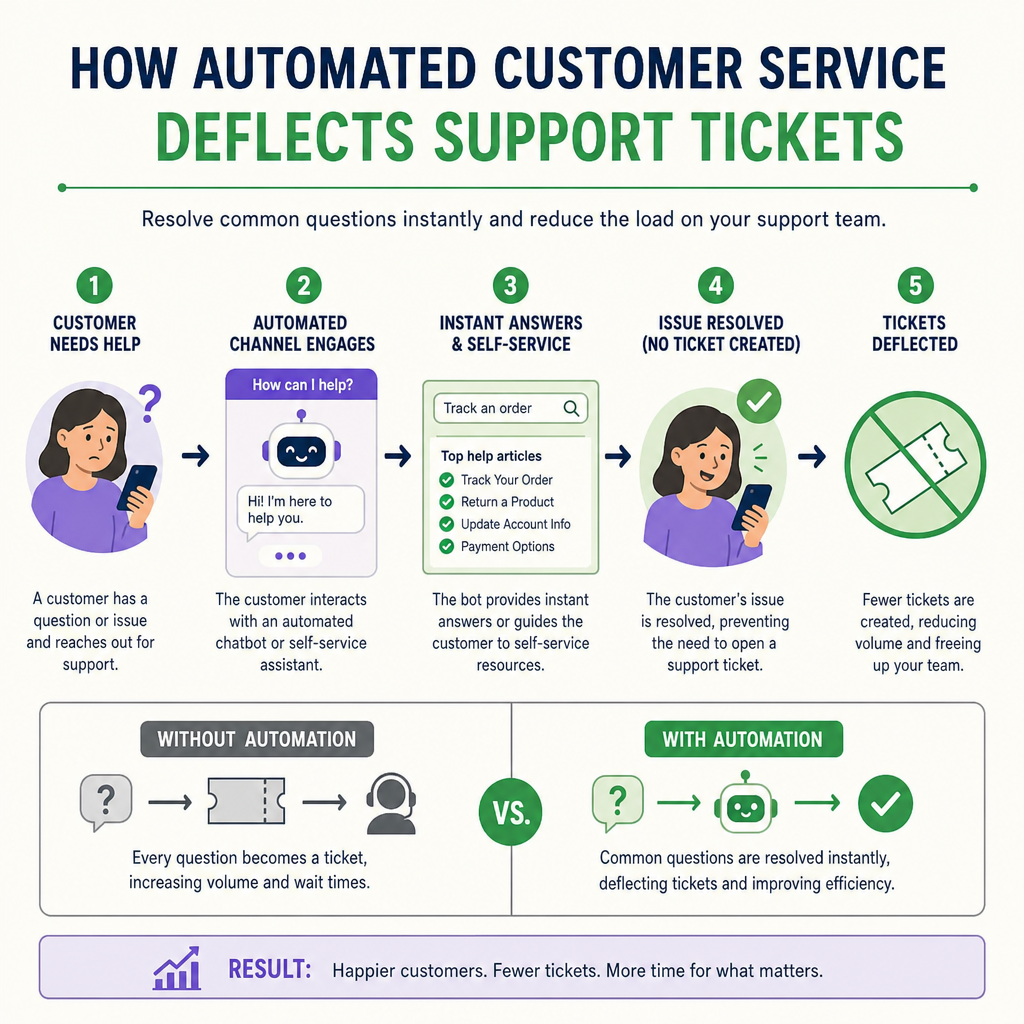
Before you even think about hiring, you need to optimize your current setup. Many founders answer the same five questions over and over again. By implementing automated customer service for small e-commerce brands, you can drastically cut down the noise.
Here are actionable strategies for reducing daily ticket volume for solo founders:
- Create a Robust Self-Service Portal: Your FAQ page should be easy to find and incredibly detailed. Cover shipping times, return policies, sizing guides, and product care.
- Automate Order Tracking: Install a dedicated order tracking page on your Shopify store. Integrate this link into your order confirmation and shipping update emails.
- Implement Smart Chatbots: Use an AI chatbot to handle the most basic inquiries. A good bot can instantly tell a customer their order status or link them to your return policy, deflecting up to 30% of incoming tickets.
- Fix the Root Cause: If 50 people ask how a shirt fits, don't just keep answering the ticket—update the product description on your website.
The Tipping Point: When to Hire Your First Support Agent for Shopify
Even with the best automation, a growing store will eventually require human intervention. So, exactly when to hire first support agent for Shopify?
There is no magical number, but a good rule of thumb is when you are spending more than 1 to 2 hours a day handling support, or when you are receiving upwards of 20 to 30 non-automated tickets daily.
Another massive catalyst is seasonality. Managing Shopify support during peak seasons—like Black Friday/Cyber Monday (BFCM) or the holiday rush—can break a solo founder. If you are approaching Q4 and your ticket volume is already steadily increasing, you need to hire before the rush hits. Training a new agent in the middle of Black Friday is a recipe for disaster.
The Big Dilemma: Virtual Assistant vs. Customer Service Agency
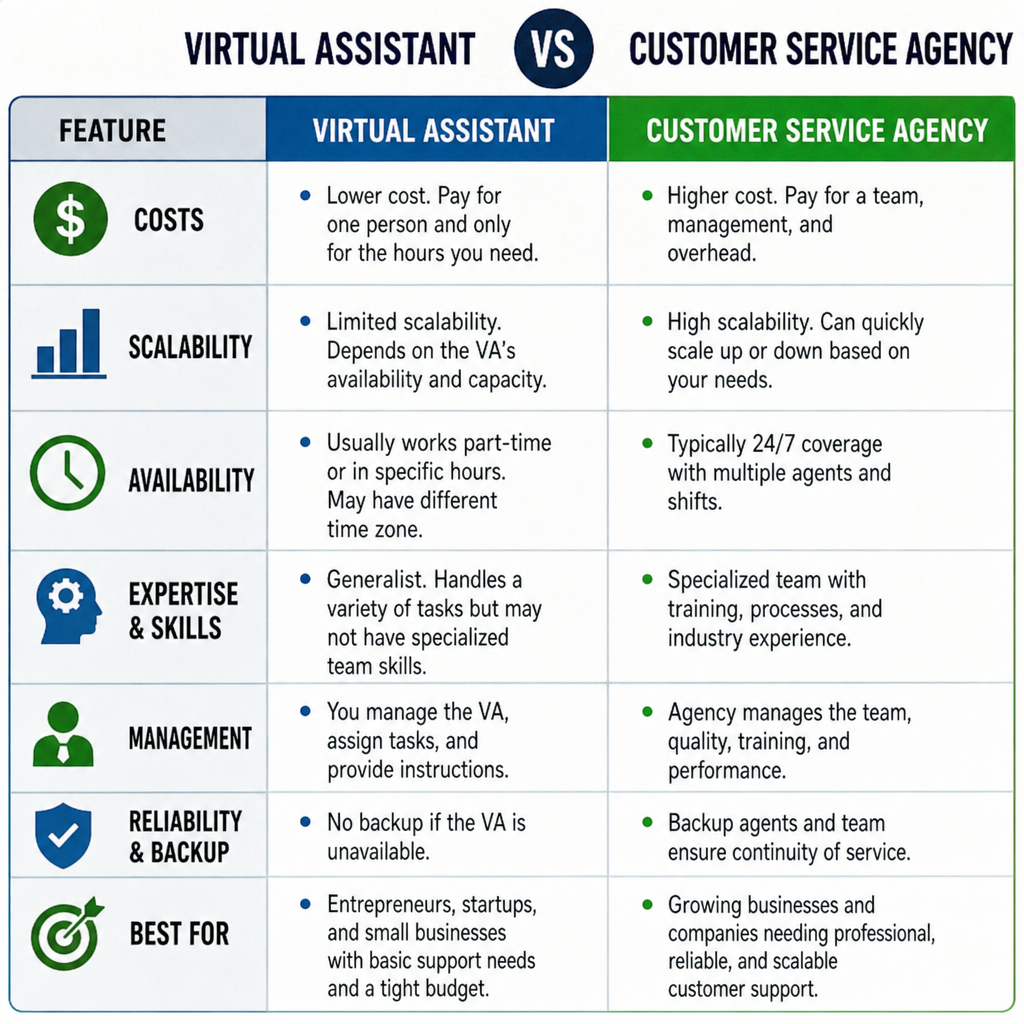
Once you decide to hire, you face a critical fork in the road. Should you hire a freelance virtual assistant (VA) or partner with a specialized agency? Understanding the nuances of a virtual assistant vs customer service agency is key to making the right choice.
The Virtual Assistant Route
Hiring a freelance VA from platforms like Upwork is often the cheapest route.
- Pros: Highly cost-effective, you have direct control over their daily tasks, and they can often wear multiple hats (e.g., handling support and basic data entry).
- Cons: You are entirely responsible for their training, management, and quality assurance. If they get sick or quit, you are instantly back to square one.
The Customer Service Agency Route
Specialized e-commerce support agencies offer managed teams.
- Pros: They provide fully trained agents, handle their own management/QA, and offer built-in redundancy (if one agent is sick, another steps in). They also know Shopify inside and out.
- Cons: Higher upfront costs and less flexibility in having them do non-support-related tasks.
Running an Outsourcing Shopify Support Cost Benefit Analysis
To make the right choice, perform an outsourcing Shopify support cost benefit analysis.
Calculate your own hourly rate as a founder. If your time is worth $100/hour driving growth, and you spend 15 hours a week on support, that's $1,500 of "lost" founder value every week. Paying an agency or a dedicated VA a fraction of that cost yields an immediate positive return on investment, freeing you up to scale the business.
But a lingering fear remains for many founders: is outsourcing customer service good for CX (Customer Experience)? The answer is a resounding yes—if you equip them properly.
Customers care about two things: speed and accuracy. A dedicated outsourced team will respond to your customers in 15 minutes, whereas a burnt-out founder might take 24 hours. Faster, accurate responses equal happier customers.
Blueprint for Success: How to Delegate E-commerce Customer Service
Handing over the keys to your inbox is terrifying. To ensure a smooth transition, you must approach delegation systematically. Scaling Shopify customer support effectively relies entirely on your preparation.
1. Creating Standard Operating Procedures for Shopify Support
You cannot expect a new hire to read your mind. Before bringing anyone on board, you must document everything. Building standard operating procedures for Shopify support (SOPs) is non-negotiable.
Your SOPs should include:
- Brand Voice Guidelines: Are you formal and luxurious, or casual and friendly? Include a list of approved emojis and vocabulary.
- Ticket Categorization: How to tag and sort emails (e.g., Returns, Defective Product, Shipping Delay).
- Resolution Workflows: Step-by-step instructions on how to process a refund in Shopify, how to generate a return label, or how to reship a lost package.
- Escalation Rules: Clear guidelines on what not to do, and which specific, high-priority issues must be escalated back to you (the founder).
2. Selecting the Best Helpdesk Software for Scaling Shopify Stores
If you are still managing support out of a standard Gmail inbox, it is time to upgrade. You cannot effectively delegate or track metrics without proper software.
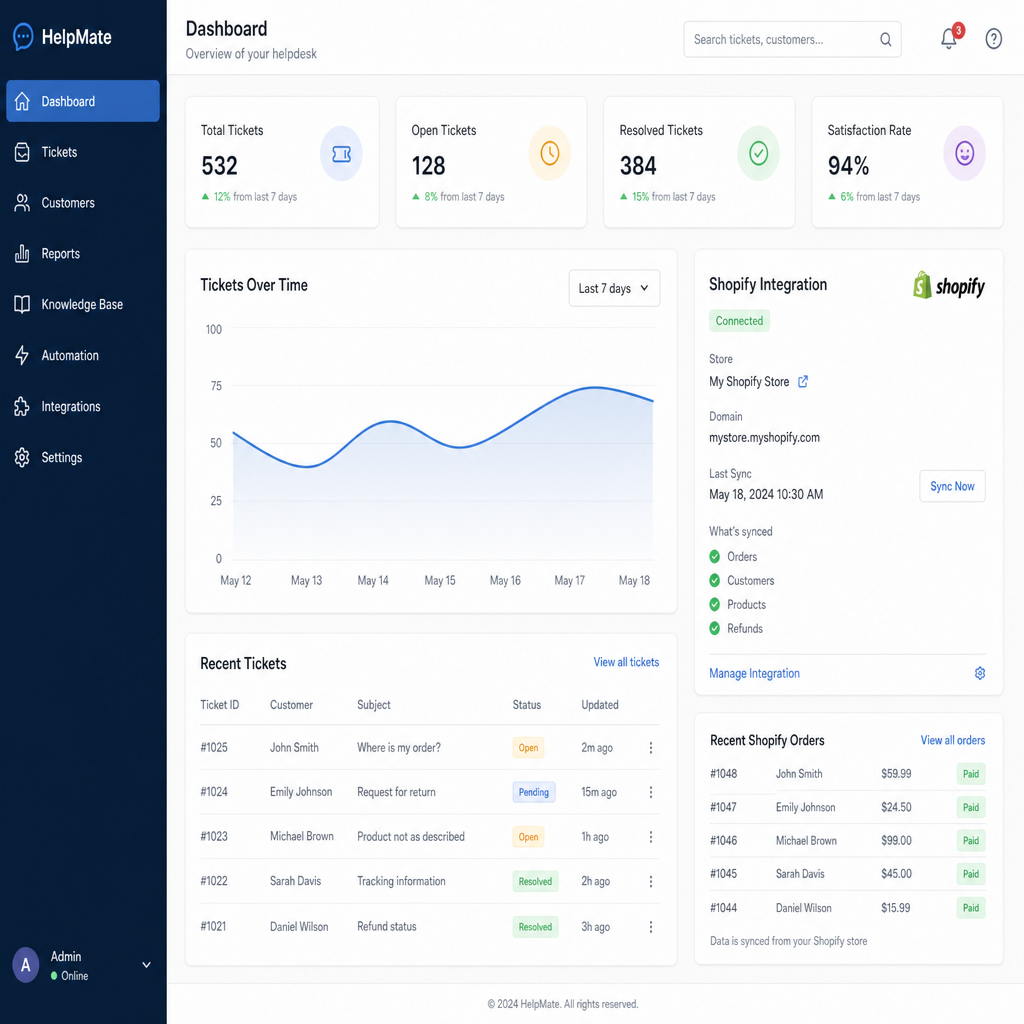
When searching for the best helpdesk software for scaling Shopify stores, look for platforms built specifically for e-commerce, such as Gorgias, Zendesk, or Reamaze. These tools pull customer data directly from Shopify, allowing your agent to see the customer's order history, tracking link, and lifetime value right next to their message. They also allow you to create pre-written responses (macros) and automate rules, which drastically speeds up resolution times.
Smooth Operations: Transitioning Founder-Led Support to a Remote Team
The final step in overcoming support fatigue is executing the handover. Transitioning founder-led support to a remote team should be a phased process, not a sudden dump of responsibility.
Here is how to structure the handover:
- Phase 1: Shadowing (Week 1). Give your new agent read-only access to your helpdesk. Have them read your past tickets to understand your brand voice, how you handle angry customers, and how you apply the SOPs in real-time.
- Phase 2: Drafting (Week 2). Allow the agent to draft replies to incoming tickets, but do not let them hit "send." You will review their drafts, provide feedback, tweak the language, and then send it yourself. This builds their confidence and ensures quality.
- Phase 3: Supervised Execution (Week 3). The agent begins sending replies directly. You monitor their sent folder daily, doing spot-checks and providing a weekly feedback report.
- Phase 4: Full Autonomy (Week 4+). The agent owns the inbox. You step back, reviewing only high-level metrics (First Response Time, Customer Satisfaction Score) and handling rare escalations.
Once you reach Phase 4, you will experience a profound shift. The constant pinging of notifications will stop. You will wake up in the morning and realize the inbox has already been cleared by your team.
The Takeaway: Stepping Back to Step Up
Learning how to delegate e-commerce customer service is a rite of passage for every successful entrepreneur. It requires you to let go of your ego, trust in the systems you have built, and recognize that your time is the most valuable asset your company has.
Burnout is not a badge of honor; it is a bottleneck to your success. By recognizing the signs early, utilizing automation, choosing the right outsourcing partner, and building bulletproof SOPs, you can protect both your mental health and your brand's reputation.
Ultimately, outsourcing your support isn't about stepping away from your customers—it is about ensuring they get the fast, dedicated, and high-quality service they deserve, while you focus on building a brand they will love for years to come.
Take your evenings back. For just $10 an hour, you can hand your entire inbox over to our trusted virtual assistants and watch your store scale passively. See our pricing to get started.
People Also Ask
- If checking your support inbox creates dread, or you're answering tickets at midnight instead of during business hours, that's a sign the workload has outgrown what one person should handle alone.
- Delegate the repetitive, low-judgment tickets first (order status, simple refunds) even before you can afford full support coverage — freeing up even a few hours a week makes a real difference.
- Yes, it's common in the first months, but it should be a temporary phase — treat it as a data-gathering period for writing your SOPs, not a permanent operating model.
Related resources
Related service pages
Want to see how this would look for your brand?
We'll walk through your current support stack, ticket categories, and tooling — and show you what an operationalized version looks like inside Zendesk, Gorgias, or Help Scout.